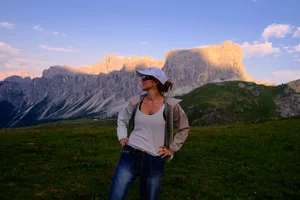
Under the Tuscan Sun: Selvoli and Claudia
What are our non-negotiables?
Field Notes — Pienza, Tuscany
Today, I started reading Under the Tuscan Sun — under the Tuscan sun.
Sitting by the pool, book dappled from the streaks of sun through the woven roof of the cabana, at Selvoli, an agriturismo in Pienza, Tuscany, I look out at the golden rolling hills, rows from tractors seemingly carved into the expanse below. Olive groves and rosemary hedges on each side. The rows of lavender below are catching that golden afternoon Tuscan light.
Claudia, the owner of Selvoli, moves through this land the way someone does when they've known it their whole life — unhurried and certain.
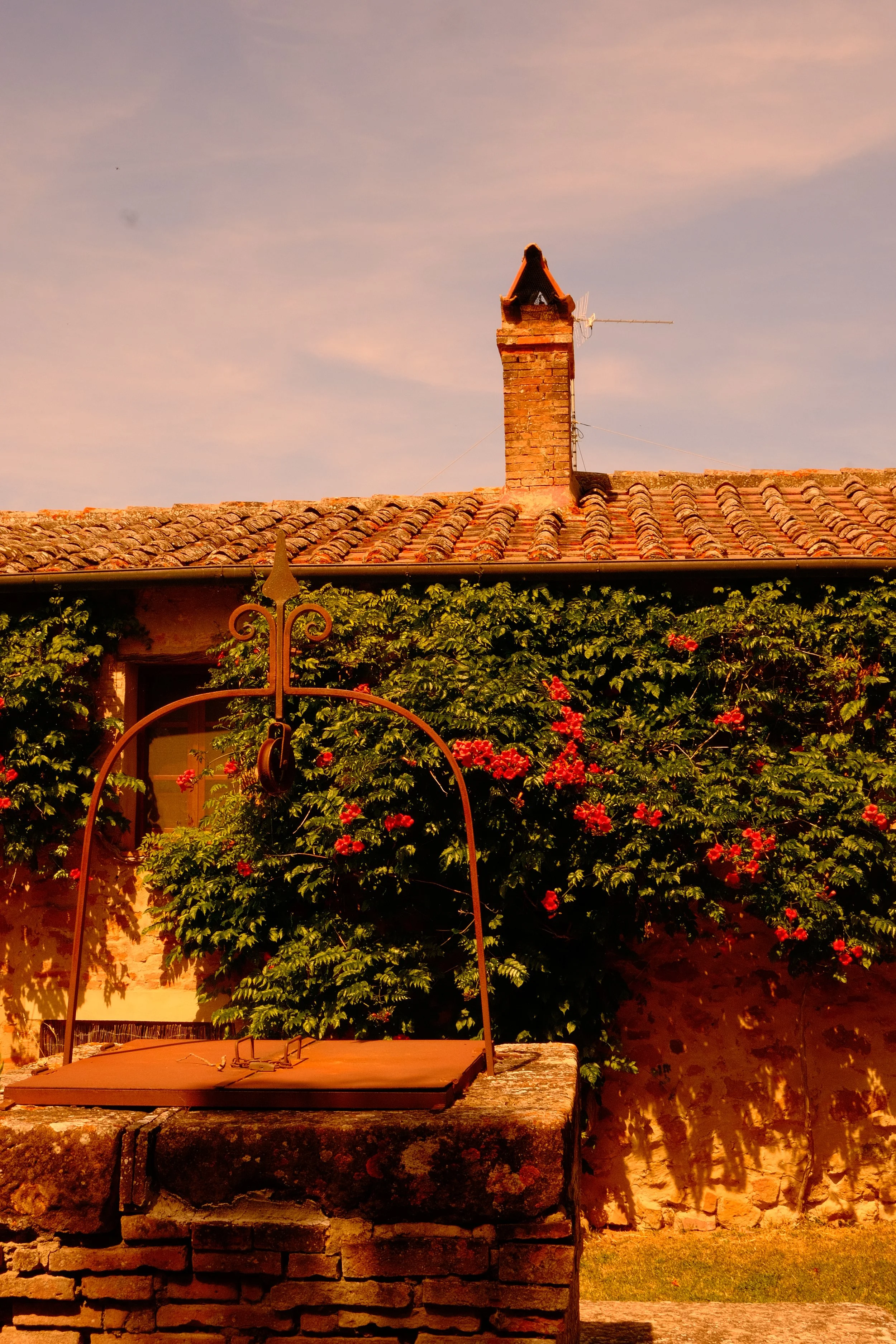
When she introduced us to Selvoli, she took us on a tour of the property, as my boyfriend was helping photograph her lovely property. Between the cover crops and olive groves, you can feel the history of this place. Her various fields. The rows. An old well. The original olive groves her father planted forty years ago. Her sweet hound Vità chasing pheasants out of the brambles. Showing us her newer rows of olives — planted around three years ago — she mentions that they leave the space between the rows mostly untouched since transitioning to organic. A four-year certification process she recently completed for her rows of lavender.
When I asked why they made the switch to organic farming, her answer was simple:
"Because it's better for the environment."
And that was that. So matter-of-fact. So certain. To her, it was non-negotiable. The work was hard, but the why wasn't complicated.
It wasn't an easy transition. It took convincing her mother, who worried, reasonably, that organic farming would cost more. A concern that's universal, no matter where in the world you're farming. But that didn't stop Claudia. And now they have organic rows of lavender, organic olive groves, old and new.
You might have heard of people who are gluten or dairy intolerant back home, but they come to Italy and eat it all — senza problemi. I'm one of those Americans. Here, all I need is a lactose pill and I can eat pecorino, gelato, and crema amarena until my heart's content. If I ate this way back home, at the quantity I have this year, you might not be hearing from me for a while.
Walking into a grocery store in the states is exhausting in a way that's hard to explain to people who haven't felt it. Not knowing what you can eat. Scanning ingredients. Trying to figure out what's been added, what's been sprayed, what your body will or won't tolerate this week. Food should be a safe space — a source of pleasure, culture, comfort. Instead, for a lot of us, it's become another industry that profits from our confusion.
We've accepted this as normal. And I understand why. We were handed a system designed to keep that connection invisible — our grocery stores advertising a "land of plenty," normalizing the availability of out-of-season food year-round, concealing the distance your food travels so that pomegranates in summer and strawberries in winter don't raise any questions. The average consumer was never meant to ask too much. Here, I can make a wonderful 5-ingredient meal, walking into a grocery store that doesn’t leave me with the same kind of anxiety or overwhelm I feel in the states.
Our commercial grocery store system back home is set up to remove any of our responsibility. Because without a strong food system with non-negotiables that act as a universal line of integrity, there is no need to question the current as-is system.
Italy isn't a perfect food system. I want to say that clearly — industrial agriculture has made its way here too. But what it runs up against is something harder to erode: a culture that has decided, collectively, that quality is non-negotiable.
That word again.
But I’m not talking about non-negotiables with policy or government or even the market. I’m talking about cultural non-negotiables. And it’s not because Americans don't care. I genuinely don't believe that. I think it's because we've lost the connective tissue between the people who grow food and the people who eat it. We don't see farmers as protectors of our culture, our health, our land, and without an established culture defining our non-negotiables, we let the market determine our priorities. We've let that relationship go quiet. And when that connection goes quiet, the market fills the silence.
This isn't a story of Italy having it all figured out, the struggle to fairly compensate sustainable farmers is not uniquely American. It is instead a story of a different set of values shaping a different set of problems. Here, farmers are still seen as stewards. Of the land, of food traditions, of something worth protecting. And that framing — quiet as it is — changes everything.
My time in Italy has taught me a lot, but Claudia helped me outline something specific, no matter where in the world, we have similar struggles — sustainable farmers searching for compensation, a lack of buy-in from the government and the market, monopolies, monocrops, and industrial agriculture, and sustainability still feeling like an uphill battle.
It is important to recognize these struggles as universal, as an international reminder that others care, that we aren’t alone. I will say this until I go blue in the face, food is universal. It unites people, across languages, cultures, and countries. And the progress made in one spot of the world, can inspire others across the pacific. So let this piece act as an example — the inspirational words of an italian organic farmer, translated through me, to you.
Claudia and Selvoli have been a wonderful reminder of what it feels like to be near someone who has never lost that. Who wakes up knowing what the land asks of her and answers without hesitation. Whose non-negotiables are generations deep into the soil.
For now, under the Tuscan sun, I'm choosing to admire, observe, and dream.
And to sit quietly with the question her answer left me with, and prompt you, my lovely reader, to ask yourself
— what are ours?