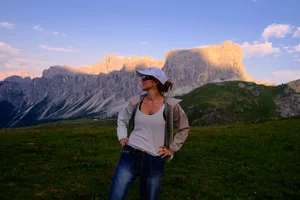
An Embodiment of Regenerative
“This is what regenerative looks like: a practice of leaving the world better, because someone had the courage to choose selflessness in a system that rewards selfishness.”
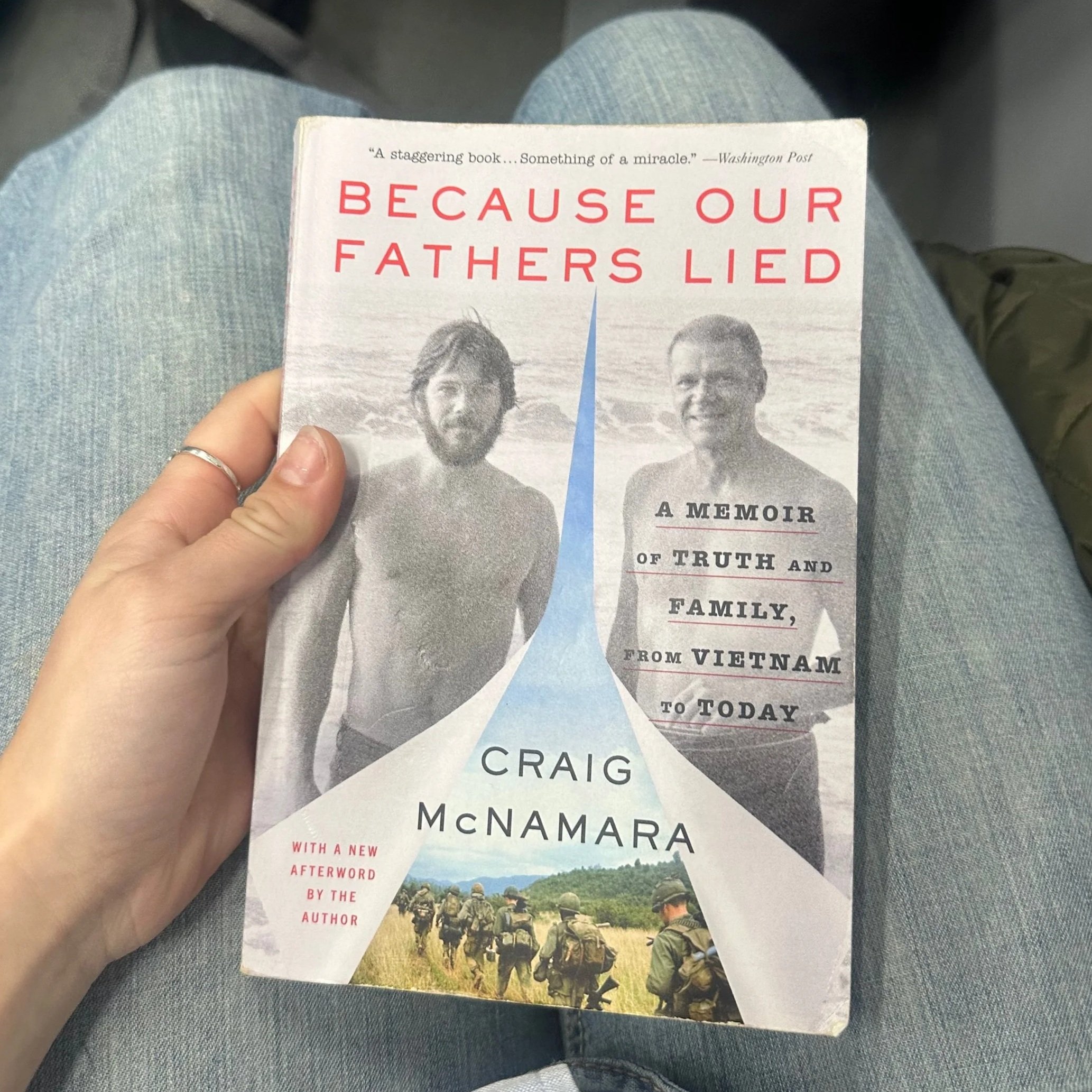
I wasn't planning on crying on the train from Lake Como to Bologna, but sitting next to my overstuffed backpack and my five new travel buddies, I opened the book Craig McNamara had gifted me earlier this summer in Winters, California. The book? His autobiography, signed with a flourish and a sweet note of our budding friendship. In the first 20 pages he discusses the protests during the escalation of the Vietnam War and mentions a black rolling chair in his office that sits primarily unused. The rolling chair that used to belong to his father, the infamous Robert McNamara, where he presumably sat, peering out the window into the courtyard of the Department of Defense (DoD) headquarters while a protester burned himself in an anti-war protest of self-immolation. The book laid across my lap, sitting on a train thousands of miles away, I was hit with a wave of emotion: this is the same chair I sat in when I visited Craig this summer.
Craig McNamara carries himself with a quiet strength; wise, kind, and deeply sincere. Sitting here, seeing Craig's life unfold in front of my eyes, how unique it is to read of such a dark time in American History contrasted through the eyes of a man who is so honest and kind. His last name, the McNamara name, follows him and identifies him as his father’s son, but going into our meeting, not truly knowing his history and the complex life he has led before, I got to meet him as a regenerative farmer in Winters, California.
When I arrived at Sierra Orchards that summer morning in mid July, Craig took me into his office with various artworks, news articles, a card from Michelle and Barack Obama, and some entertaining framed political comic strips. He drove me around his orchard in an ATV, telling me of how he fled the US, hitchhiked and biked to South America, a search for adventure and a decision rooted in his frustration with the current state of our country. An immeasurable frustration and weight I could feel, but can now see, through his written words.
Craig shared that during his abroad adventures in South and Latin America he fell in love with this world of farming, his experience leading him to that very orchard we were driving through. When we got back to his office after my very first regenerative farm tour, I could feel my curiosity and journalistic tendencies taking over. I asked if his experience farming abroad and their more natural, three-dimensional, more integrated approach to farming was what drove him to transform his conventional farm into an organic and regenerative farm, now recognized for its rows of Regenerative Organic Certified walnuts. He acknowledged that was a key influence and continued to explain his complex reasoning for transitioning to regenerative farming, a combination of following what felt right and what he believed the reality of farming should and could be.
Craig, I can't seem to articulate the buzz I felt as you spoke and shared your story. How lucky I felt to be there, meeting an important man who had accomplished so many incredible things, while continuing to strive for good. From whom I had so much to learn and someone I am now lucky enough to call my friend.
I can't help but see parallels to his story—feeling the need to leave the US while finding so much inspiration abroad—to where I am right now, an Environmental Systems University of California student studying abroad in Bologna, Italy. While our reasons for leaving may have their differences, there was a similar spark achieved abroad. There is something so similar in our dreams, to experience the unfamiliar and allow a more integrated, developed foreign food culture to inspire us. A dream that has led us down a new road—a search for quality and a clean, fair food system in the States. Something similar in two inspired souls dedicating their lives to something seeming so impossible, a dream many label as naive, unrealistic, and insignificant.
But there he was, showing me the mountain of walnut shells he recycled into compost and the river he had restored. Crushing feces under his boots, he showed me the broken pieces of red shells from sea crabs that crunched with his step, left behind by the river otters that had returned after his river restoration efforts. The water source that fed his walnuts, restored and now the breeding place of shimmering salmon on their annual adventure upstream.
Standing there in the shade of the trees he had brought in to hold the riverbed, shadow the waterway, and lower the temperature so the salmon would return, tears began to swell. I can only imagine the time, effort, and money to get this project from start to finish, or the difficulty of achieving the grant to tackle a project at this scale. For those of you versed in environmental conservation, and for those of you without any experience, let it not be understated, this waterway restoration project was an enormous accomplishment. While the list of benefits from these restoration projects is long, it is important to stress, restoration is anything but cheap. The sheer cost and effort required to bring life back to a fading ecosystem made the accomplishment itself remarkable. Witnessing it firsthand, seeing my last 4 years of studies put into practice, I was taken aback by my emotional reaction to the river. There was something deeply human about it, something so real and personal, qualities that reflected the selflessness I saw in Craig.
One of the first things one is taught in an entry-level environmental science class is the Tragedy of the Commons, a simplified example of the selfishness of man. This economic theory states that when land is shared, man will act in their own self-interest and overuse the land, even at the expense of the health of the grazing pasture. Simplified, man prioritizes short-term gain over long-term sustainability, ultimately destroying the pasture and their own livelihood in the process. (Sounds like they could’ve used a lesson in regenerative farming!).
Waterways are an even more complex example of the Tragedy of the Commons outlined by Garrett Hardin. You’re not just polluting or damaging a local resource, but you’re creating “negative externalities,” that is, effects that impact the greater community and trickle downstream to your unhappy neighbors. I dedicated my senior project to regenerative agriculture certification, but my fascination with certifications actually began with a fascination for the management of waterways. ECON 145 at UC San Diego, the Economics of Ocean Resources, discussed the inefficiencies of the fishing industry and the economic models of overfishing.
In a capitalistic economy obsessed with profit and financial gain, I couldn’t wrap my head around the idea that we had statistical proof that our management of the fishing industry wasn’t just ecologically unsustainable, but it was financially inefficient. My professor explained that the reason we had yet to fix this inefficiency and find a balance to reach the socially optimal outcome was because, drumroll, the ocean is our greatest shared resource. And while we may be able to make the calculations, and be able to statistically understand these inefficiencies, how were we supposed to monitor our greatest example of Hardin's Tragedy of the Commons? Sustainable Certifications? That’s a start. But we realistically cannot monitor something so grand, especially when connected to the difficulties of monitoring a migratory species, it will unfortunately continue to function inefficiently and overfishing will continue. A cycle of selfishness that seemed impossible to break, until I got my first glimpse into the actions of selfless farmers, monitoring their negative externalities and limiting their damage downstream while cleaning up after upstream polluters.
A bit of a detour, but I wanted to help outline how complex waterway management is, and how it’s one of the most unselfish aspects of environmental restoration. Because you’re not just tidying up your home, but taking care of the mess from your upstairs neighbors and helping minimize the impact on your downstairs neighbors.
So as I stood there watching the water flow past the trees Craig had planted, I realized this was more than restoration work, it was an act of radical selflessness. In a world where the Tragedy of the Commons tells us people will always act in their own interest, he chose the opposite. He invested his time, money, and energy not for quick profit, but for a river, for salmon, for neighbors downstream, for a system that will outlast you.
Sitting on that train, his book sitting across my lap, my notebook in hand, it struck me that this theme runs through his life: to be the good in the midst of selfishness, to choose integrity when everything around you teaches you otherwise. Even with the weight of his father’s legacy, the pain and contradictions he carries, he has chosen to heal, to restore, to give back. Knowing all the good he has done, and all that he has gone through, brought tears to my eyes. Because what is more impossible, and more inspiring, than being good and holding onto kindness in a world so full of manipulation, division, and lies?
And this, I realized, is what regenerative farming really is. It’s not a label, trend, or a marketing strategy. It’s the embodiment of what my dad always told me growing up, and what my sweet Nonny had always told him: leave it better than you found it. This message is what lies at the root of regenerative agriculture. Practices based in kindness, in empathy, in a willingness to share the “good” with those around you. Watching Sierra Orchard’s river run clear, my glossy eyes mixed with the streaks of the sun's rays on the flowing water, giving the illusion of salmon shimmering back upstream, I realized that this is what regenerative looks like: a practice of leaving the world better, because someone had the courage to choose selflessness in a system that rewards selfishness.
I pride myself in my ability to simplify complex scientific environmental topics for the consumption of the average consumer. This has led to a fascination with environmental communication and this dream of environmental storytelling. As I shared with Craig my dream and my previous experience in my senior internship in regenerative agriculture certification, he shared his financial struggles to maintain a regenerative and organic certified operation. He outlined how the inconsistency of farming has made obtaining certification on all of one's acres and orchards increasingly difficult, something I had become well aware of in my internship task of leading Braga Fresh’s regenerative certification search.
As our ATV tour was coming to an end, Craig shared his recent partnership with GoodSAM PBC, a Public Benefit Corporation, and Heather K. Terry, the co-founder and CEO of GoodSAM, who I had the pleasure of meeting in a five-minute crossover in our visit to Sierra Orchards. He outlined how this new collaboration with his regenerative walnuts would not just be found on the shelves of Whole Foods, but could be his savior from potential bankruptcy.
Craig, after everything my senior thesis had taught me and all I know about the lack of financial compensation for regenerative farmers, it surprised me that this surprised me. Maybe it was because you were, well, famous? Maybe I believed your name would somehow save you from the financial struggles so many regenerative and sustainable farmers face? I'm not sure. But even in this struggle, you still had that glimmer in your eye and an aura of hope, joy, and gratitude. I wonder if you saw that same glimmer in my eyes, a dreamer inspired by another dreamer.
When my visit had come to an end, he sent me home with a bottle of his Sierra Orchards olive oil and a signed copy of his autobiography. When we bid our goodbyes, I tried not to get too emotional.
Meeting Craig McNamara was a lot more to me than meeting a regenerative farmer, or meeting someone of historical significance, it was a reminder that I am not alone. Call me what you want: a dreamer, an optimist, a believer, a creative soul, a tree hugger, an environmentalist. I'd say I'm a bit of it all. In today's world, with the next big headline of the world's recent tragedy shoved down your throat the second you open your phone, it's exhausting being optimistic. And for those of you that share my environmental passion, I'm sure you can agree that it's not the most emotionally relaxing career choice. Caring is exhausting. And unfortunately, convincing everyone else that they should also care is naturally built into your personal responsibilities, a weight on your shoulders that will never be lifted. But meeting Craig and hearing his story, a little bit of that weight was lifted. Not because it went away, but because for a second, it was shared. His story and his regenerative farm were a beautiful reminder of all the good that goes on behind the scenes, and that we aren't alone in not just this journey for equitable, healthy food systems, but in our journey for universal good.
When we said our goodbyes and I got into my car, I opened up the front cover of my new gift and read, “To Raquel, With deep appreciation for our new friendship. In peace, Craig McNamara.” Sitting there in the driveway of Sierra Orchards next to the shed that held his father's old black rolling chair, I cried. I cried for myself, for Craig, for all of my environmental dreamers who feel the pull of isolation and burnout, and most importantly, I cried for myself and my dream of becoming a regenerative storyteller.
Because as I drove away towards my next adventure, I realized I hadn't just found an inspiring story or a new friend, but inspiration that would stick with me for the rest of my life. Inspiration that would follow me all the way to Bologna, Italy. A visit and friendship that will leave me crying on the train in Italy realizing that I had found it, my first story of regenerative farmers and their universal struggles to stay true in a world that could use a little more good.